Author: Karen Mitchell

  • Pearl Lam Galleries – Opening Show in Singapore
    Pearl Lam Galleries – Opening Show in Singapore

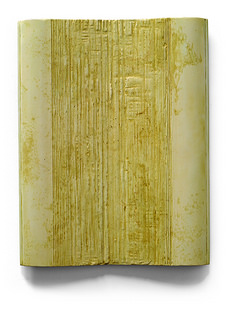
    Pearl Lam Galleries is a recent newcomer in the galleries-filled Gillman Barracks. To mark the gallery’s beginning in Singapore and opening, they presented ‘Where Does It All Begin? – Contemporary Abstract Art in Asia and the West’, curated by Philip Dodd. (more…)
  • ART by Nine Years Theatre

    ART by Nine Years Theatre

    ART-03

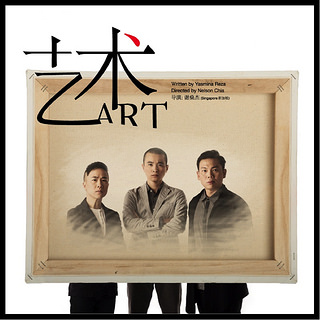
    Hailed as her best-known comedic work, ART by French playwright Yasmina Reza is a woman’s keen observation of the complexities of friendship between men. This play has also won numerous awards in London and New York.

    Created by the team behind ‘Who’s Afraid of Virginia Woolf?’ (Huayi 2012) and ‘Twelve Angry Men’ (Huayi 2013), and directed by Nelson Chia, this production gathers three of the most acclaimed male actors from the Singapore Mandarin theatre scene – Oliver Chong (钟达成), Peter Sau (苏佳亮) and Liu Xiaoyi (刘晓义), in this humorous and poignant performance. They are also director Chia’s ‘dream casts’. Chia has always wanted to work with them, and this time, the casts came before the decided script, and they fit perfectly into their characters.

    ART-01

    The synopsis:
    Bosom buddies for the past 15 years, Serge, Marc and Yvan’s friendship is put to the test when Serge decides to pay a ridiculously high price for a modern painting – a white canvas with a few faint, white lines. Tension ensues when Marc calls the painting “a piece of white shit” and Serge decides to defend it stubbornly. Their differences in taste quickly degenerates into a relentless attack on each other’s failures in life. The absurdity of the situation escalates when Yvan, who is caught in the middle, vacillates between Serge and Marc as he tries to save the deteriorating friendship.

    The three characters held within themselves very different background and belief, and yet they have been friends for 15 years. Both Sau’s and Liu’s characters of Marc and Serge demonstrate a strong stubbornness and insecurity in their search to be better than each other, but at the same time, needing the assurance and confirmation from each other. They seem to be very alike, but their individual success and failure in life separates this closeness. Chong’s character of Yvan, on the other hand, is always trying hard to lighten everyone’s problem and be Mr Good. His weakness is emphasize, by his two friends, who do not realize that behind the joker’s optimism in everything in life, Yvan is suffering silently alone.

    In the seriousness of the matter that the friendship among the three men may be jeopardize by a painting, the humour never cease to lighten the mood, or up the argument to a notch. Audiences are tickled by the actors’ superb expression that are so natural that you forgot you are watching a play. All three actors display full confidence in delivering their characters, totally engaging the audience in the short one and a half hours’ performance. No one is better than anyone, as they compliment one another’s character seamlessly. I fell in love with the lines of the entire play, they are like music to the ears delivered by the actors, even the parts where they are furiously arguing.

    ART-02

    Nine Years Theatre’s production is always packaged with little surprises to be discovered here and there. In ‘Who’s Afraid of Virginia Woolf?’, we were treated to the delicately-built set by Wong Chee Wai and lighting design by Lim Woan Wen; In ‘Twelve Angry Men’, the sound of the rotating fan filled up the heated jury room, the rain, accompanied by occasional thunder, cooled the exterior of the nicely crafted set; In ‘An Enemy of the People’, the open-stage concept treated the audience to the experience of actors’ existence from on-stage to off-stage. In ‘ART’, besides the three main casts, the live piano performance by Darren Ng has to take cue and act with script too. With a theatre company that takes heart into such details for their production, the audience has the privilege to better enjoy the performance, and truly supporting the theatre scene. (more…)

  • Boedi Widjaja: Drawing Cage

    Boedi Widjaja: Drawing Cage

    Boedi-cover

    Coming from a small town, I find the city peculiar – the linearity of its physical environment and the non-linearity of its time.” Boedi Widjaja

    It is quite assuring to be able to recognise and have self-awareness of one’s relationship with his environment, surrounding and the time that he spent with them.

    We always feel that we are safer within a familiar space and we are sure of our actions and consequences. However, after viewing artist Boedi Widjaja’s third solo exhibition ‘Drawing Cage’, I felt that it is just the opposite – it is, when we are in a totally alien space, that we have a stronger sense of self-awareness and very much conscious of the space we are in. Every detail gets magnified and the distance between ourselves and the strangeness gets measured, dissected, analysed; we think about our actions and decision within this space and anticipate the consequences. The need to understand this unfamiliarity actually gave us the opportunity to close-up the distance, or even discover new connection.

    IMG_7977

    Drawing Cage (Unfinished)

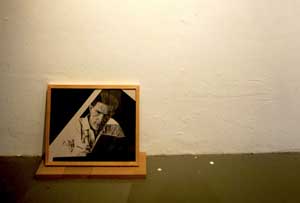
    In this exhibition, Widjaja has presented both new and some older works. The works revolve around the concept of space and time, memories and displacement. In the room, every work gets a space on the wall, with carefully adjusted lighting, except for ‘Drawing Cage (Unfinished)’, which sat on the ground, leaning against the wall. This works measures 42cm by 50cm, with medium graphite on paper. It has a drawing of a face that looks like John Cage. Widjaja explains that while researching into ideas on space-time, he came across articles on American avant-garde composer John Cage, and his works. He acted on the impulse to draw a portrait of Cage, but was unable to complete it. Widjaja perceived that the distance between him and Cage was too wide to overcome. Hence, he needs to explore other ways to make Cage’s portrait, and to find the connections that would draw him closer to the subject.

    It is this distance and unfamiliarity that give the opportunity for finding possible connections, consciously. The interesting story of stone tracing emerged:

    Cage devoted the last decade of his life making stone tracing – inspired by his trip to temple-garden Ryoanji, Japan – that were guided by chance-based operations. Independently, Widjaja has been using stones in his practice, aleatoricism as method, and had travelled to Japan just before work on Drawing Cage started. The connection is idiosyncratic, almost (appropriately) random.

    This sparks off the ‘Drawing Cage’ series.

    DrawingCage_installation

    *Photograph provided by artist.

    Drawing Cage_22.72

    *Photograph provided by artist.

    Whimsical ideas on the concept of space-time also bring us to an addition to Widjaja’s ‘Path’ series. This series was triggered by the artist’s change of citizenship, and is an on-going project that investigates into notions of place, origin and identity in the context of the porous Asian global city.

    In this exhibition, ‘Path. 5, Silent Conversation with a Friend, 2014’ is on display. The making of ‘Path. 5’ took place in more than 20 public spaces in Singapore, such as cafes, libraries and void decks. Widjaja used drawing as a method to connect and (re)create, this time with 12 friends and to the 13 places in Singapore that he had at one time resided in. The work speaks of time spaces found in friendships and of their transformative potential.

    Boedi-Path 5

    Path. 5, Silent Conversation with a Friend, 2014

    The little installation in the center of the room draws interest from the viewers and invite them to play a game about time. ‘Jam, Berapa? (What, time?)’ speaks of individual’s perception of time. The use of clock-time to meter days, to standardize our time with others’, is amplified in the city. This behaviour was not the norm for Widjaja, growing up in a small town. Back then, time somehow beat to your rhythm. Time was a non-committal numerical subjected to one’s bending at will. Try it with a friend and compare the time that your bodies have separately clocked.

    (more…)